
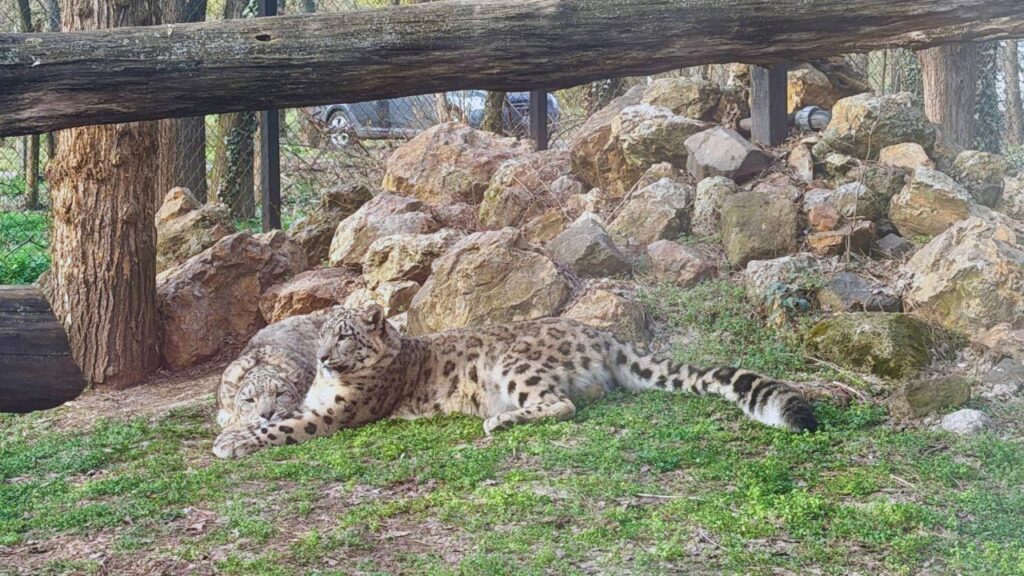
Love is in the air… The Szeged snow leopards have paired up!
It’s no exaggeration to say it was love at first sight when Karma, the female who arrived in 2024, and Tai Lung, the male who arrived at the end of last year, first met. Even the keepers were surprised that they didn’t hiss at each other—even through the barrier—which is quite rare among big cats.
It was already clear then that the two animals would get along very well, and after a few months of getting to know each other, their introduction went smoothly. Since then, the air has remained charged between them—they spend most of their time cuddled up together in their shady enclosure, so we can hope to see cubs again at the Szeged Zoo.
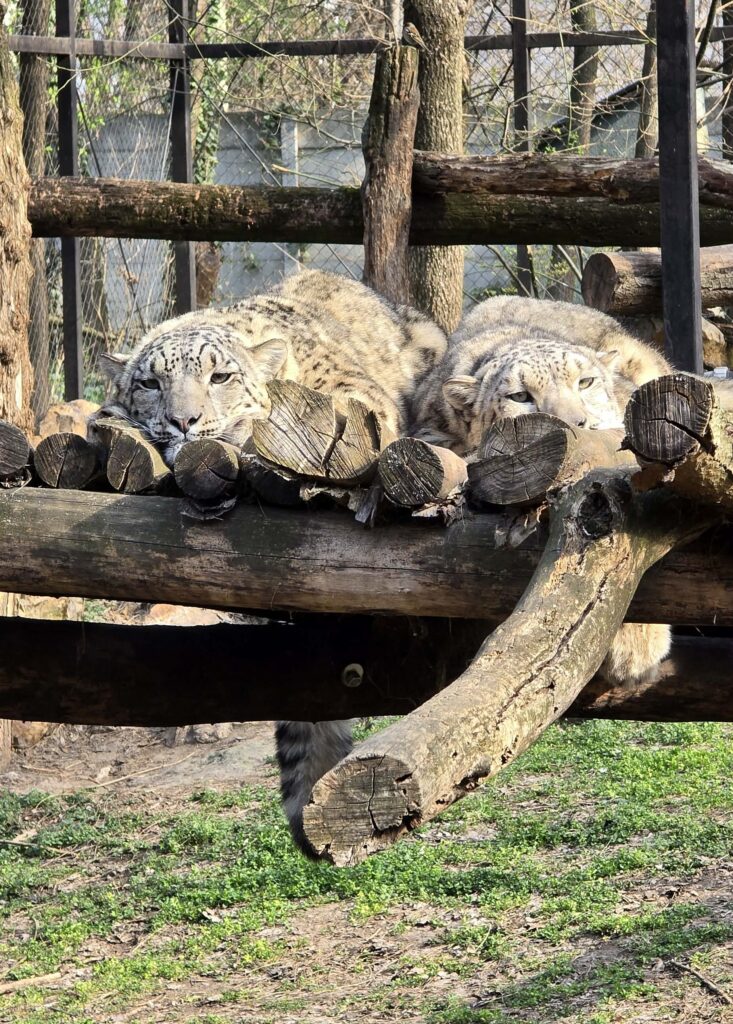
Snow leopards have been among our most special and beloved residents almost from the very beginning. Our first pair, Ghandi the snow leopard and Gongga the snow leopard, successfully raised several litters; in 2012, it was internationally rare when they gave birth to triplets.
The snow leopard, living at elevations between 2,000 and 5,000 meters in the high mountains of Central Asia, is one of the most elusive members of the cat family. With its powerful legs, it can make enormous leaps—up to 15 meters in distance or 6 meters in height. Its large, soft, furry paws allow it to land silently. Its pale, spotted, thick fur provides excellent camouflage among snowy rocks and protects it from extreme cold. Its winter coat is not only long but double-layered: beneath the outer layer lies a wool-like undercoat close to the body.
Due to its remote habitat and secretive lifestyle, there is no reliable data on the global population size; available figures are best considered estimates. Their numbers are thought to be between roughly 3,000 and 6,500 individuals, scattered across nearly 3 million square kilometers. Fewer than 500 snow leopards are kept in captivity.
They occasionally prey on livestock, which leads herders to kill them using traps, guns, or poison. Poaching for their valuable fur also reduces their population, and their bones are still used in traditional Asian medicine. Because of their rarity, elusive nature, agility, and strength, the peoples of the Himalayas often call them “ghost leopards.” They are a national symbol of Tatarstan and Kazakhstan, and they are also a symbol for mountaineers.