
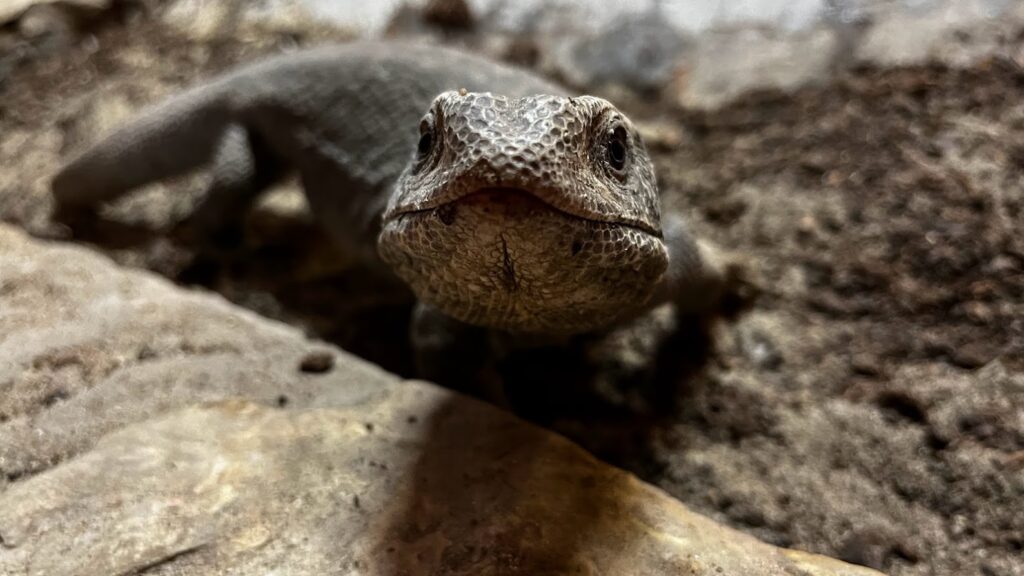
Animal talk&feeding: Savannah Monitor
The savannah monitor inhabits areas south of the Sahara in Central and East Africa, particularly Tanzania and Kenya. It can be found in savannahs, semi-deserts and tropical deciduous forests. Although it usually moves along the ground, it also enjoys climbing onto rocks and tree branches.
It is a favourite “dinosaur” among reptile enthusiasts, although caring for one is not as simple as it may initially appear. Besides its large body size, it also has above-average exercise requirements and therefore needs a relatively spacious enclosure. Males grow considerably larger than females and may reach a length of 100 centimetres.
Its body structure differs slightly from that of many other monitor lizards. Its head is shorter and blunter, its neck is short, and its thick, oval-shaped tail is used for storing fat. These reserves help it survive periods when food is scarce, making the savannah monitor a remarkably resilient survivor.
Its colour is generally greyish-brown, and its body is covered with circular yellowish markings that resemble volcanic eruptions. Its strong legs end in sharp claws that help it move across the ground as well as dig and scratch. It explores its immediate surroundings by repeatedly extending its long, forked tongue. Its jaws contain numerous small, needle-sharp teeth.
The savannah monitor has a diet that differs from that of most other monitor lizards. Its feeding pattern is seasonal: food is abundant during the wet season but scarce during the dry season, when the animal undergoes a period of fasting. During this time, it obtains the necessary nutrients from its accumulated fat reserves.
This seasonal pattern must also be considered when keeping the species in a terrarium. Young animals are fed every one or two days, while adults receive food every four or five days. Savannah monitors can easily become obese if their diet is unsuitable or they do not get enough exercise.
They are not particularly selective feeders, and their diet includes a wide variety of foods, ranging from insects and snails to rodents, eggs and carrion. Young animals feed mainly on arthropods, but as they grow, they begin hunting progressively larger prey.
Savannah monitors are curious, intelligent reptiles capable of learning. Precisely because of these qualities, they must be watched carefully, as they can easily open a terrarium that has not been secured properly. They can recognise their keepers and learn when it is time to be fed.
They express their displeasure by hissing and striking powerfully with their tails. If we devote enough time and attention to them, we can gradually gain their trust and accustom them to being handled.