
Alpaca (Vicugna pacos)
Studies on different archeological sites in South America suggest that alpacas were domesticated approximately 6000 years ago. In 2001, however, Kadwel et al. shed light on the controversy when they found through genetic analysis that vicugnas are the wild ancestors of alpacas.
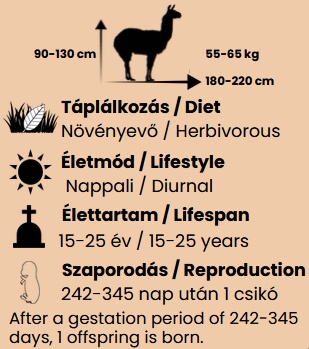
Food habits: the alpaca diet is dominated by grasses.
A remarkable trait of South American camelids is their ability to interbreed and produce fertile offspring. The hybrid resulting from a llama and an alpaca is known as a huarizo, which exhibits intermediate physical characteristics. The cross between a vicuña and an alpaca is called a paco-vicuña, which more closely resembles the wild vicuña in appearance.
Native to the Andes, the alpaca has evolved to thrive in extreme environments characterized by sparse vegetation and significant diurnal temperature fluctuations. Their exceptionally dense fleece provides insulation against sub-zero nocturnal temperatures. Conversely, during the intense heat of the day, alpacas utilize a unique thermoregulation method: by wetting their bellies, they facilitate cooling through evaporation.
They possess a specialized three-chambered stomach designed to maximize nutrient extraction from low-quality forage. Their dental structure is also specialized, featuring incisors only on the lower jaw. Similar to the llama, the alpaca utilizes “spitting” (the expulsion of stomach contents) as a primary defensive mechanism.
Alpaca fiber is globally renowned as one of the finest and silkiest natural fibers. Today, the species is farmed worldwide, typically being shorn every two years. Their wool is used to produce high-end textiles, including soft, thermal blankets, gloves, and sweaters.
Artiodactyla / Camelidae