
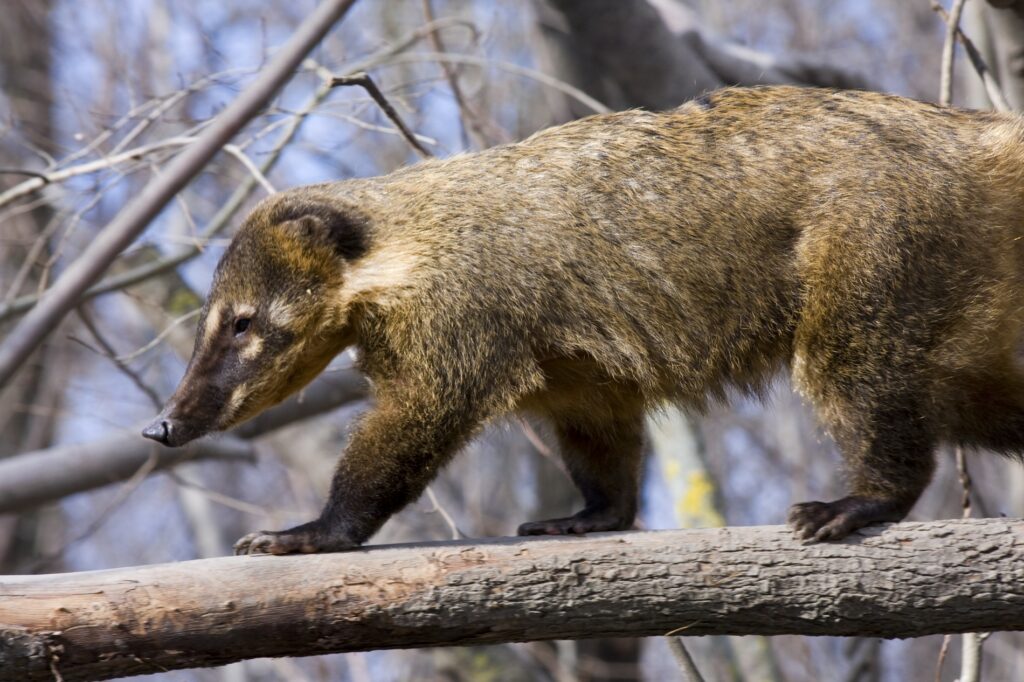
Animal talk&feeding:South American Coati
The coati belongs to the raccoon family. It is a remarkably adaptable animal found in a wide variety of habitats, ranging from the southern regions of North America through Central America and into South America.
The body part that gives the coati its name in Hungarian – its trunk-like nose – is also one of its most highly developed sensory organs. Its long snout provides a large surface area for detecting scents, and it can also bend through an angle of approximately 90 degrees. This allows the coati to smell food hidden beneath the ground and then dig it out with its powerful claws.
Although it is a close relative of the raccoon, its way of life is rather different. It moves with equal skill in trees and on the ground and is also a good swimmer. While climbing among branches, it uses its long, black-ringed tail for balance. On the ground, it holds its tail upright like an antenna, helping group members keep track of one another. Coatis are mainly active during the day and spend much of their time in trees, where they also sleep at night.
Females and their young form loosely organised groups of 10–20 individuals. During the breeding season, the otherwise solitary males temporarily join these groups. After mating, the females drive the males away and withdraw to build nests, where they give birth to their young.
The family groups formed by females and their offspring have a close but strict social hierarchy. Like monkeys, they groom one another, strengthening the bonds between group members. Coatis can produce a wide range of vocalisations. They can often be heard communicating with chirping sounds, while a call resembling a cough is used to warn one another of danger.
The coati is an omnivore. It readily consumes plant material but also raids birds’ nests and eats small vertebrates, insects and worms. Here at the zoo, their menu is equally varied, with meat-based and fruit-based days alternating. Their favourite treat, however, is undoubtedly the mealworm.
The South American coati is still relatively widespread, although illegal hunting may threaten its long-term survival. Indigenous communities have hunted it for its meat for centuries. Its young are also easily tamed and are therefore frequently kept as pets.
The species was formerly a popular exotic pet in several European countries, including Hungary. Since 2016, however, it has been classified as an invasive alien species in the European Union, meaning that private individuals are prohibited from breeding or selling it.