
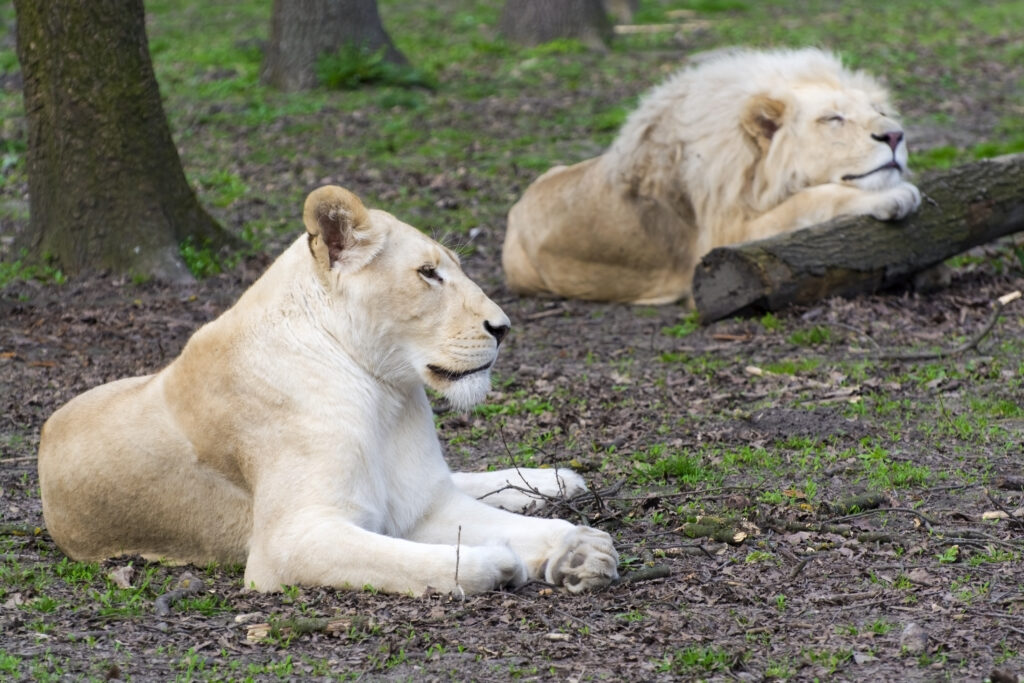
Animal talk&feeding: South African Lion
Known as the king of animals, the lion is admired throughout the world and is one of the most popular inhabitants of zoos. It belongs to the cat family and, after the tiger, is the second-largest big cat. Lions live primarily in Central and Southern Africa, although a small population also survives in India. They have become extinct in North Africa, Europe and most of Asia.
Among South African lions, also known as Kruger lions, an unusual colour variant sometimes occurs. Although these animals are commonly called white lions, this term can be misleading. They are not albinos lacking pigment but have a distinctive pale beige coat. This colour variant developed naturally and survived, perhaps because it provided an advantage in its original habitat, such as helping the animals blend into their surroundings.
The white lion is one of Africa’s most mysterious animals. Its existence was suspected for centuries, but very few people had ever seen one. The first written record dates from the 1930s, although it was initially dismissed as a product of the imagination. In 1975, however, a biologist happened to encounter white lions while travelling with his family and took photographs of them.
The last wild individual was seen in 1994, leading many to believe that the colour variant had disappeared from nature. Since then, however, light-coloured lions have once again been observed in the wild. According to the International Species Information System and other sources, approximately 230–300 “white” lions live in zoos around the world. Zoos seek to preserve the genes responsible for the pale coloration and therefore often keep and breed these lions together. However, they can also reproduce with normally coloured lions, as they do not constitute a separate species.
Lions differ from most other big cats in both their appearance and their way of life. Adults have a uniformly coloured coat, usually sandy in colour. Unlike their parents, cubs are born with spots, which begin to fade when they are approximately three months old.
Males are larger than females and have a mane that covers the head, falls back over the shoulders and often extends across much of the chest. This crown of fur helps protect the animal during confrontations while also serving as a symbol of strength, health and reproductive fitness.
The lion is the only truly social cat species. A pride may consist of between 2 and 40 individuals, including one or more males, several females and their cubs. If several males lead a pride together, they are usually related and are most often brothers.
Lions mark the boundaries of their territory with urine. Their characteristic roar also serves to advertise ownership of the territory while strengthening the bonds between members of the pride. The faster and more agile females carry out most of the hunting, while the males patrol the territory and defend the pride against threats.
When new males take control of a pride, they may kill cubs fathered by the previous males. This causes the females to become receptive again sooner and allows the new males to pass on their own genes.
Lions are polygamous, meaning that one male may mate with several females. They have no fixed breeding season and can reproduce throughout the year. After a gestation period of approximately three and a half months, the female gives birth to 1–5 cubs, although litters of 2–3 are the most common. The females of the pride help one another care for and raise their young.
Unfortunately, the conservation status of lions is a cause for concern. Their populations have declined dramatically over the past century, and habitat destruction and poaching continue to pose serious threats to their survival.