
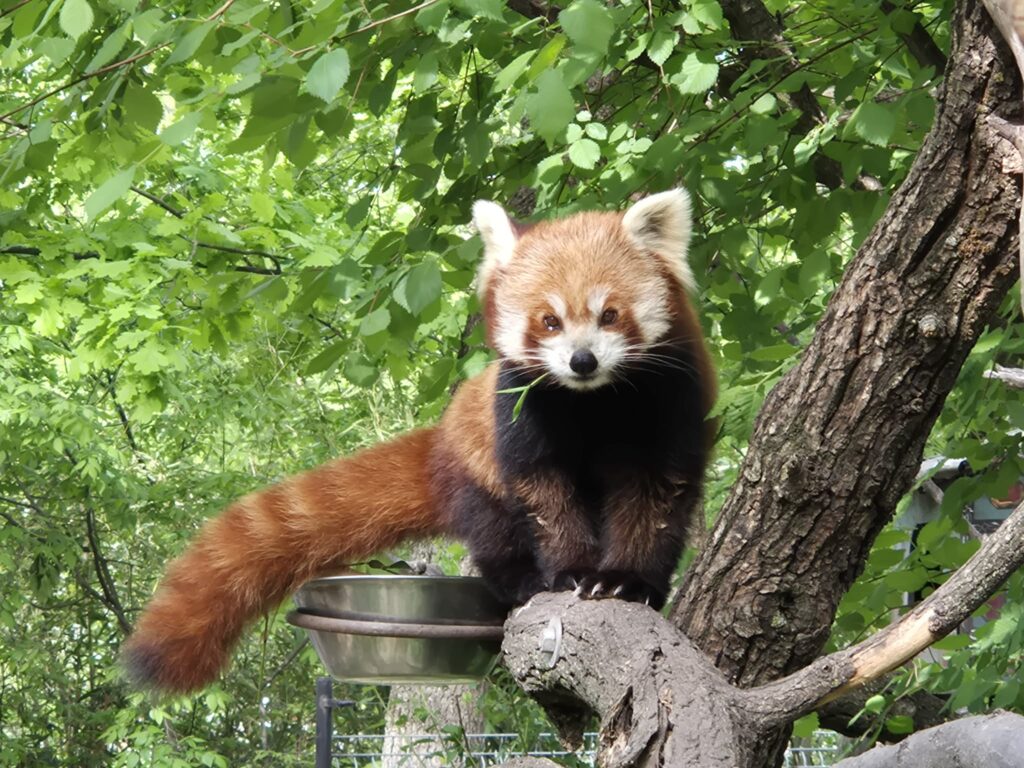
Animal talk&feeding: Red Panda
The red panda is one of the most popular animals in zoos and a favourite of countless visitors. Its popularity is not due solely to its adorable appearance: it is also a truly remarkable species. It is the only living member of the red panda family.
Its body shape resembles that of a bear, which explains part of its name. It frequently climbs trees, where it grooms itself in much the same way as a cat. In addition, its pupils are not round but oval-shaped like those of a domestic cat.
The word “panda” is thought to derive from the animal’s Nepalese name, punja, meaning “bamboo eater”. During the 19th century, the red panda and the giant panda were believed to be closely related, but scientists have since discovered that this is not the case. The two species have only two significant features in common: both belong to the order Carnivora and both have diets specialised around bamboo.
The red panda was discovered first and was the animal originally given the name “panda”. The giant panda became known much later. Because it resembled the red panda but was considerably larger, it was named the giant panda.
The red panda inhabits forests in the Himalayan mountain range of Asia at elevations between 2,200 and 4,800 metres. It is an excellent climber and likes to rest in the forest canopy, spending relatively little time on the ground.
In the wild, it lives alone, with males and females meeting only during the breeding season. It is nocturnal and generally sleeps during the day, using its bushy tail as a pillow and wrapping it around itself like a blanket.
Its beautiful red coat is long and dense, providing protection against the cold. Unlike most animal species, the fur on its underside is darker than that on its back. When threatened by a predator, it first turns its black belly towards the attacker.
The red panda appears to have six digits on each front paw. The additional “sixth digit” is actually an enlarged wrist bone that can move against the other digits, helping the animal grasp and pull off bamboo shoots with ease.
After waking and feeding, the red panda usually licks its entire body clean. It also uses its paws to wash its face like a cat. Afterwards, it stretches and rubs its back and belly against a tree branch or rock.
Although it belongs to the order Carnivora, the red panda eats mainly plants, with bamboo being its favourite food. It is not particularly selective and also readily consumes fruit, lichens, berries, insects, caterpillars and birds’ eggs.
Only around 8,000–13,000 red pandas now remain in the wild, and their population has declined by approximately 40% over the past 50 years. Habitat loss and fragmentation caused by deforestation pose the greatest threats in India and Nepal, while poaching is the main danger to this rare species in Myanmar and China. In China, red pandas are killed primarily for their fur, and hats made from their pelts are commonly sold in local markets.
European zoos coordinate the keeping and breeding of red pandas through the European Endangered Species Programme (EEP). Interestingly, the red panda is one of the few zoo species with more females than males in the managed population, as considerably fewer males appear to be born.
Although the red panda is a popular zoo animal, it reproduces slowly. Zoos often have to wait several years before they can acquire individuals of the species.