Animal talk&feeding:Greater One-horned Rhinoceros
Our first two greater one-horned rhinoceros were Csülök and Akeno, both born in 2018. Csülök arrived from Nyíregyháza, while Akeno moved from England to Szeged, the City of Sunshine, in the autumn of 2020. After reaching sexual maturity, Csülök moved to Wrocław Zoo in May 2026.
Although Akeno is already an impressively large animal, he still has some growing to do. Greater one-horned rhinoceroses can reach a height of 180 centimetres at the shoulder and weigh as much as three tonnes.
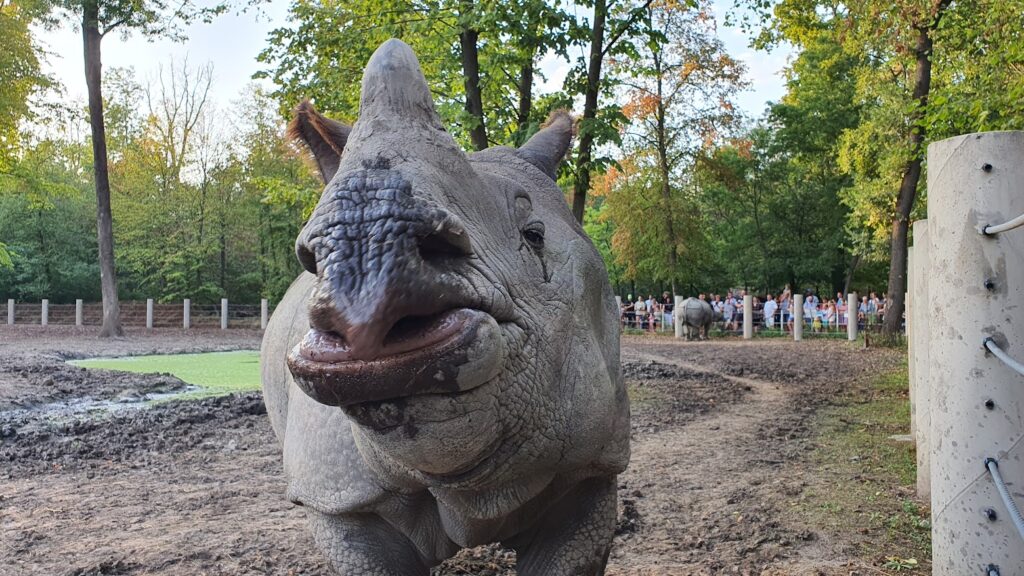
The greater one-horned rhinoceros is the largest Asian rhinoceros species. Its skin is deeply folded, giving it an appearance reminiscent of the armour worn by medieval knights. For this reason, it is also known as the armour-plated rhinoceros.
Akeno may appear very friendly, but he is only comfortable with people he already knows. We therefore ask visitors not to attempt to touch him under any circumstances. Rhinoceroses have very poor eyesight, and if startled, they may charge through almost anything at speeds of up to 50 kilometres per hour. Their hearing and sense of smell, however, are excellent.
These rhinoceroses are herbivores, feeding on grasses, leaves and fruit. They consume approximately 1% of their body weight in food every day. Their flexible upper lip helps them grasp vegetation while grazing.
In the wild, greater one-horned rhinoceroses generally live alone, with males and females meeting only during the breeding season. Males establish territories that they defend fiercely against other males, although females are allowed to move freely through them.
After a gestation period of 16 months, the female gives birth to a single calf weighing approximately 60–80 kilograms. The calf drinks 20–30 litres of milk each day and gains around 1–2 kilograms in weight daily.
Greater one-horned rhinoceroses love wallowing in mud. This not only helps them regulate their body temperature but also protects their skin from pathogens and blood-sucking parasites. The layer of mud provides their already thick skin with additional protection.
Conservation efforts for the greater one-horned rhinoceros have achieved considerable success. At the beginning of the 20th century, fewer than 200 individuals remained, whereas today the wild population numbers more than 3,500. Despite this recovery, the species is still considered seriously threatened.
Alongside habitat loss, poaching remains the greatest danger to these rhinoceroses. Their horns are believed to possess medicinal properties in traditional Eastern medicine. A conservation breeding programme has been established to support the species’ long-term survival, and Szeged Zoo also participates in this programme.
A female may arrive from France to join Akeno in approximately two years.