
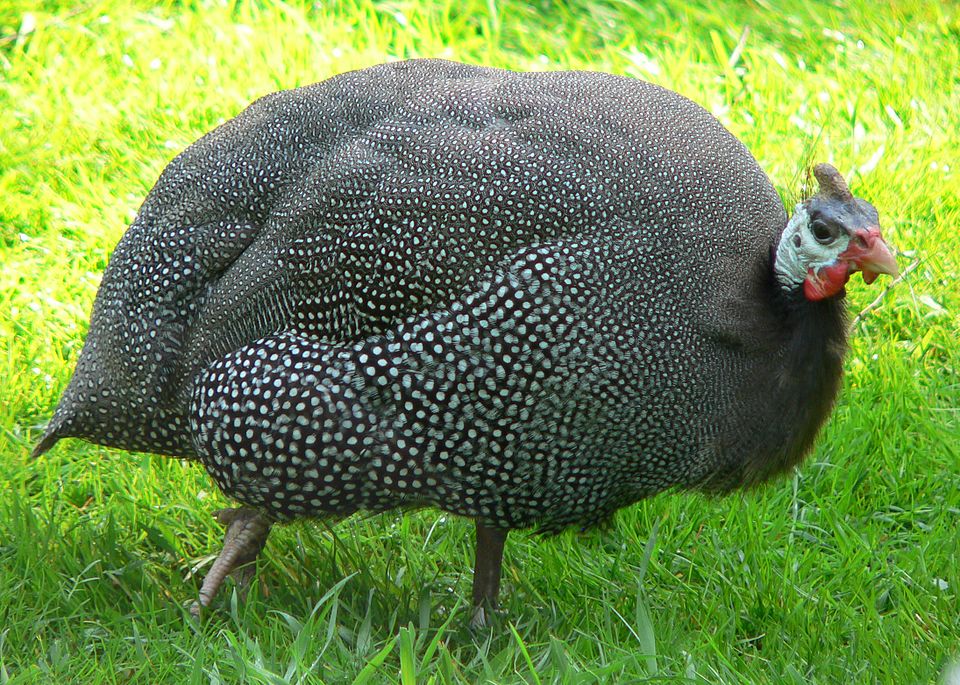
Guineafowl (Numida meleagris f. domestica)
Order: Galliformes
Family: Numididae
IUCN Red List: –
Habitat
The guineafowl is native to Africa, where it lives in family groups of 15–20 individuals.

Information
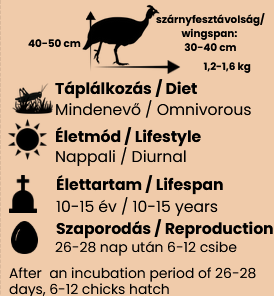
Diet: omnivorous. It bears a distinctive bony helmet (casque) on its head, which is larger on the males than on the females. Its plumage is dark with light-colored spotting. During domestication, it became slightly larger in body size, but in all other aspects, it has retained its basic wild instincts and behaviors: its nature is skittish and “quarrelsome.”
Extremely alert, it makes an excellent “watchdog,” signaling the arrival of guests long before they reach the property. It takes flight at any unusual noise. They are excellent fliers and may cover up to 10 km a day; they do not always return to their shelters for the night, often choosing to roost in a tree instead.
In Hungary, they were already being bred at the beginning of the 20th century, though their numbers declined in the 1980s. They are utilized for their eggs, meat, and feathers. The eggshells are thick, allowing them to be stored for a long time. In the 13th century, they were kept primarily as ornamental birds in monasteries and aristocratic deer parks.
The guineafowl also appears in ancient Greek mythology. According to legend, after the death of Prince Meleager, his sisters mourned him so deeply that the gods took pity on them and transformed them into birds—thus creating the guineafowl. The white spots on their feathers are said to be the sisters’ falling tears, and their plaintive cries evoke the memory of constant mourning. Because of this, the ancient Greeks sometimes called the guineafowl the “meleagris” bird in memory of Meleager, a name that still appears in its Latin scientific name today.