
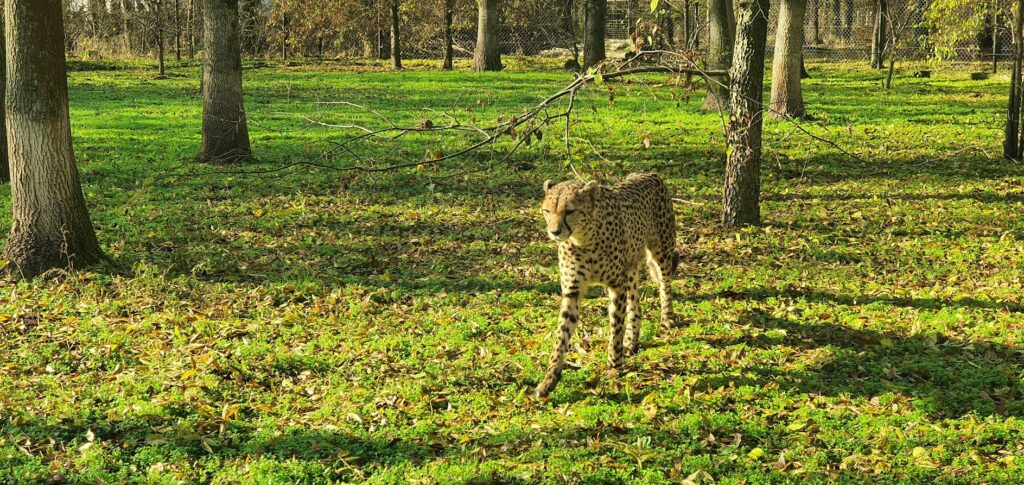
Animal talk&feeding:Cheetah
The cheetah is a distinctive predator of the savannas of Africa and Asia. Rather than relying on stealth, it uses its superior speed when hunting. Although the cheetah is often grouped with the big cats, it actually belongs to the subfamily Felinae. This means that despite its large size, it is more closely related to smaller wild cats. Its closest relatives are the cougar and the jaguarundi.
A shared characteristic of these cats is that their fully ossified hyoid bone allows them to purr but prevents them from roaring. Interestingly, however, the cheetah has round pupils like the big cats, rather than the vertical pupils characteristic of smaller members of the cat family.
The cheetah is the fastest land predator on Earth. Speeds of 93 kilometres per hour have been measured over short distances, and it may even exceed 100 kilometres per hour. However, it can maintain this speed for only a few hundred metres, as sprinting places an enormous strain on its body.
Its anatomy is perfectly adapted to this performance. Its slender body, flexible spine and small head reduce air resistance, while its long tail helps it maintain balance during rapid changes of direction. The absence of a fully developed collarbone allows its front legs to swing farther forwards. Its relatively small canine teeth leave more room for enlarged nasal passages, allowing large quantities of air to flow rapidly to its enlarged heart and lungs.
The claws on its paws are only partly retractable. This feature is also reflected in the scientific name of its genus, Acinonyx, which comes from Greek and means “non-moving claw”. The exposed claws provide better grip at high speeds and assist with acceleration and manoeuvring.
The cheetah is also easily recognised by its distinctive appearance. Its cream-coloured coat is covered with approximately 2,000 black spots, which form a unique pattern on every individual. These markings therefore serve as a kind of natural identification system, as no two cheetahs are exactly alike.
Black “tear marks” extend from the eyes towards the mouth. These stripes are thought to reduce the glare of sunlight, helping the animal see more clearly while hunting.
Females generally live alone, while males often form small groups known as coalitions. These are usually made up of brothers from the same litter, although unrelated males may occasionally be accepted into the group. Coalition members care for and groom one another and search for a companion if he remains absent for an extended period.
They have equal access to kills and food. Observations also suggest that males living in coalitions are generally healthier than solitary males and are more successful in gaining access to females.
Cheetahs were originally distributed throughout Africa and across Asia, from the Arabian Peninsula to southern India. They are now threatened with extinction. In the past, they were hunted extensively for their fur, while in Asia their numbers were particularly reduced by the capture of wild individuals for use in hunting.
Today, the greatest threats are habitat loss, increasing competition with larger and stronger carnivores, and the declining numbers of their prey. According to the International Union for Conservation of Nature (IUCN) Red List, the African subspecies is classified as Vulnerable, while the Asiatic subspecies is Critically Endangered. Only around 10,000 cheetahs remain in the wild in Africa.
Szeged Zoo participates in the European Endangered Species Programme (EEP), which aims to preserve genetic diversity and maintain a stable population of cheetahs in European zoos.