
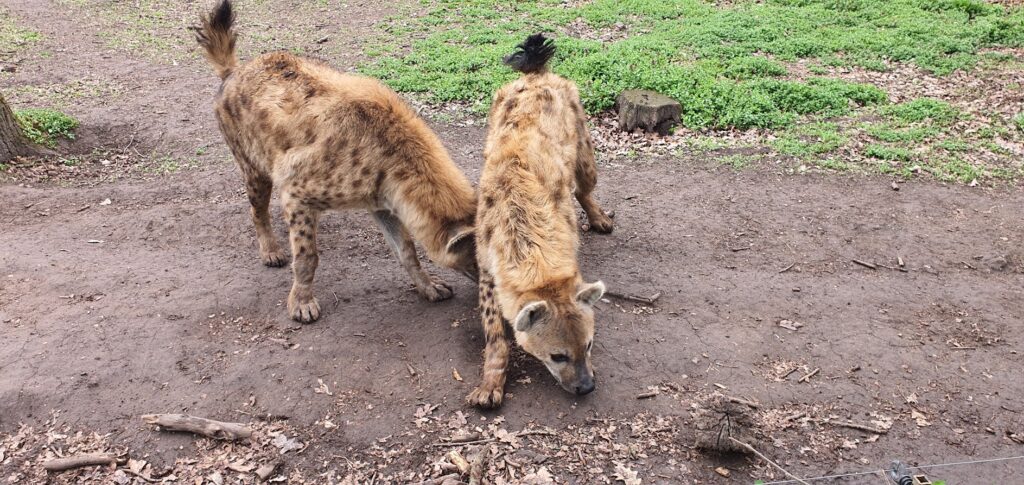
Animal talk&feeding: Spotted Hyena
The spotted hyena is the most widespread large carnivore in Africa. It inhabits open grasslands and scrublands south of the Sahara. Its appearance is dog-like, with an elongated muzzle and a yellowish coat covered in darker, oval spots. Its front legs are longer than its hind legs, giving it a sloping back and a distinctive gait.
For a long time, hyenas were judged solely on their unusual appearance and superficially observed behaviour. They were regarded exclusively as scavengers, while their calls were interpreted as sinister laughter. More thorough observations have revealed that although spotted hyenas do eat carrion – thereby playing a vital role in removing animal remains – and may occasionally even dig up human bodies from graves, they are also highly successful hunters, particularly when working as a group. Their main prey includes wildebeest, zebras and smaller antelopes.
Spotted hyenas are not only fast but also remarkably persistent hunters. They can maintain speeds of up to 60 kilometres per hour over considerable distances. One hyena was observed following its prey for 24 kilometres. Their jaws are among the most powerful of any terrestrial mammal, and their teeth can crush even thick bones.
Hyenas live in female-centred social groups. A clan may consist of as many as 130 individuals, with females occupying the dominant positions. Rank is extremely important, and even cubs “inherit” their mother’s social status. The species displays sexual dimorphism, but unlike most mammals, female spotted hyenas are larger and stronger than males.
Females are also considerably more aggressive than males and have higher androgen levels. This is associated with one of the species’ most unusual characteristics: the external genitalia of males and females appear remarkably similar. The female’s external reproductive organ resembles that of a male, which led people in ancient times to believe that hyenas were hermaphrodites. Because of this unusual anatomy, both mating and giving birth are difficult.
After a gestation period of approximately three and a half to four months, the female gives birth to 1–4 well-developed cubs with their eyes already open. The cubs are extremely aggressive and may begin fighting over access to their mother’s milk almost immediately. Fatal aggression between siblings is not uncommon.
The species is also known as the laughing hyena because of its laughter-like call. However, this sound does not express happiness. It may indicate frustration or serve as a call for assistance. It can also be heard during disputes over food, where it helps communicate social rank and determine which individuals have priority at the carcass.
Spotted hyenas are often portrayed negatively. In the animated film The Lion King, for example, they appear as the lions’ evil and deceitful enemies. Interestingly, in reality, lions steal prey from hyenas more often than hyenas steal from lions. Conflicts between the two species are inevitable because they inhabit the same areas and feed on the same prey, making them natural competitors.
Spotted hyenas are exceptionally intelligent, and their problem-solving abilities rival those of certain primates. They can cooperate during hunts and even change their strategy when necessary. They are able to estimate the size of a rival group entering their territory and launch a counterattack only when they have a clear numerical advantage and the confrontation is unlikely to result in serious losses to the clan. In general, therefore, they tend to avoid unnecessary conflict.
Thanks to their remarkable adaptability, spotted hyenas are not currently considered an endangered species.