
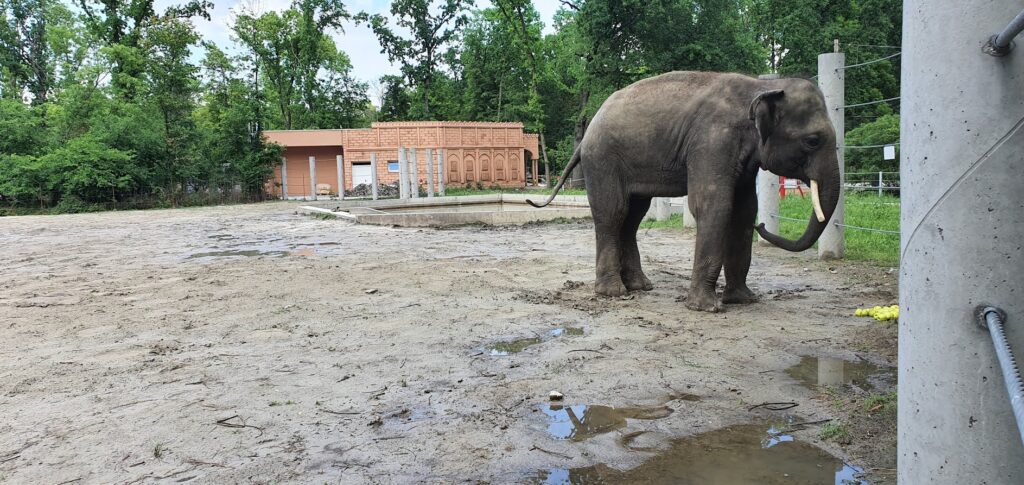
Animal talk&feeding: Asiatic Elephant Training
The three pupils of our “elephant school” are Shah-Rukh, the dominant bull, born in 2008; Félix, born in 2010; and Arun, born in 2017. Although the difference in size between them is clearly visible, all three still have some growing to do, as they are considered young elephants.
Many people believe that animals are forced to participate in training. This is certainly not the case – quite the opposite. Training contributes significantly to the animals’ physical and mental well-being, although consistency is also essential. Elephants are highly intelligent animals that need this kind of stimulation. Without regular mental and physical activity, they could develop serious behavioural and psychological problems.
However, enrichment is not the only reason why training is important. It is easy to imagine how difficult it would be to examine, treat or transport an animal of this size. Every exercise demonstrated during the training sessions helps with these tasks, as the elephants learn to allow their keepers and the veterinarian to examine them at close quarters.
Elephants’ feet are very sensitive, so they require regular care, including trimming their nails. The command to lift a foot makes this possible. The elephant remains still with its foot raised until the trainer signals that it may lower it again, allowing routine foot care to be carried out safely.
On request, the elephants also raise their trunks. This behaviour is required for tuberculosis screening and allows staff to inspect their mouths and check the condition of their teeth.
The trainers can ask the elephants to move backwards or call them forward. Elephants trained to follow these instructions can also be guided calmly into a transport container. This is particularly important because it would not be possible to place an anaesthetised elephant inside one safely.
Training is based on positive reinforcement: the elephants are rewarded for performing a task correctly and are never punished if they make a mistake. Their rewards include biscuits and apples, followed by a generous portion of hay at the end of the session.
Each elephant consumes approximately 100–150 kilograms of food per day, divided into three portions. Around 30% of this consists of vegetables and fruit, while the remaining 70% is hay.
During the summer, the elephants love bathing and can often be seen splashing in their pool. Although their skin is thick, they can still be bothered by blood-sucking insects and other parasites. By throwing sand onto their wet skin, they create an additional protective layer.
Asiatic elephants are an endangered species. In addition to the loss and fragmentation of their habitat, poaching poses one of the greatest threats to their survival, as there is still considerable demand for objects made of ivory. Several sanctuaries have been established to protect the species, many of which care for rescued or injured elephants. A European conservation breeding programme has also been created to help ensure the species’ long-term survival, and Szeged Zoo is a participant in this programme.