
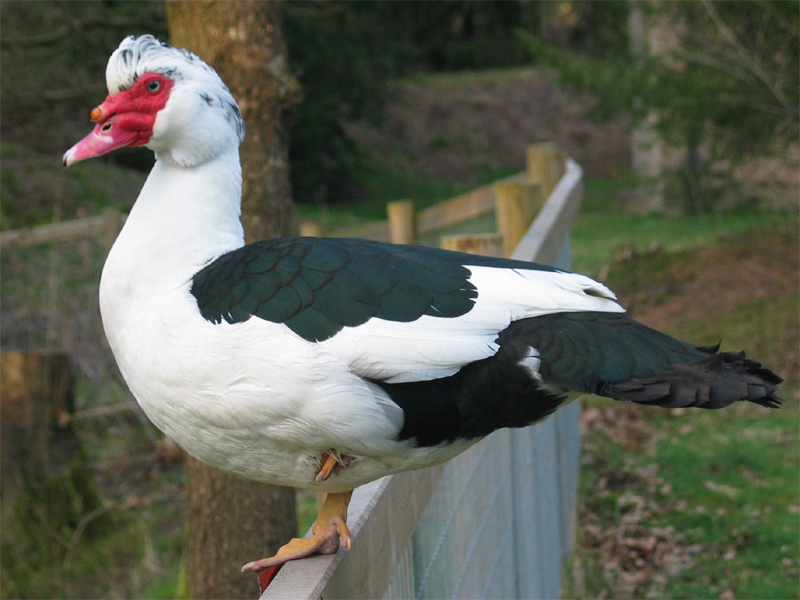
Muscovy duck (Cairina moschata)
Order: Anseriformes
Family: Anatidae
IUCN Red List: –
Domestication
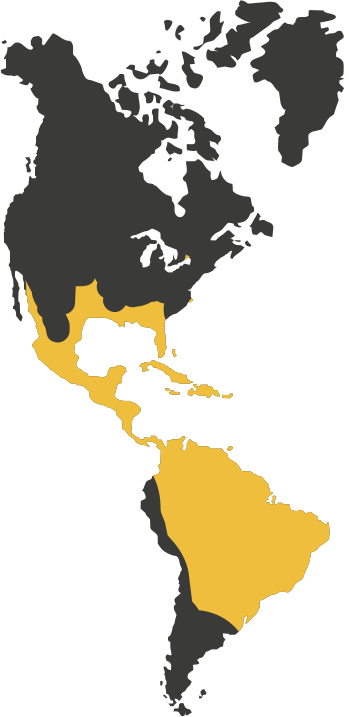
The ancestor of the Muscovy duck, is native to Central and South America. Today, both domesticated and wild Muscovy ducks are widespread worldwide.
Information
The Muscovy duck is also commonly known as the “Musk duck” or “Silent duck.” Among domesticated varieties, a wide range of colors can be found. There is a visible difference between the sexes: drakes (males) are significantly larger, and the reddish, fleshy caruncles on their faces and at the base of their bills are more prominent.
In their youth, both sexes make chirping sounds. Later, their voices become quiet; they tend to hiss rather than quack. The Muscovy duck also uses body language to communicate: it wags its tail feathers and clatters its bill. When drakes meet, they slightly spread their wings to appear larger and more intimidating.
They are primarily kept for their meat. Their meat is darker and more flavorful than that of the domestic duck, with a higher protein content and lower fat content.
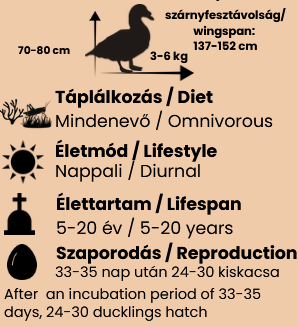
Although uncommon among waterfowl, wild Muscovy ducks spend a considerable amount of time in tree canopies, where they are experts at hiding. If startled, they take flight with slow, heavy wingbeats. During the breeding season, they are seen alone or in small groups, but at other times, they may gather in larger flocks of up to 16 individuals.