
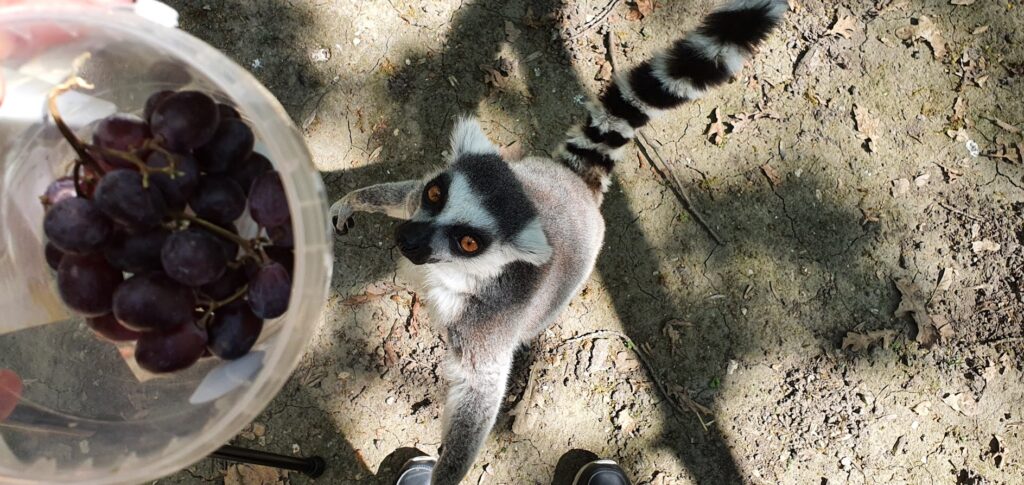
Animal talk&feeding:Ring-tailed Lemur
The ring-tailed lemur is the best-known prosimian. It inhabits dry forests and scrublands in southern and south-western Madagascar. Its most distinctive feature is its long tail marked with alternating black and white rings, from which the species takes its name. It is an excellent climber and uses its tail for balance while moving along branches. When walking on the ground, it holds its tail high like a flag, allowing other members of the group to see its position. Compared with other lemurs, it spends a considerable amount of time on the ground.
The fur on its back is greyish-brown, while its underside and face are white. Black markings surround the eyes and nose. The incisors and canine teeth in the lower jaw form a specialised structure known as a toothcomb. The second toe of each hind foot has a grooming claw, while the other digits have nails. The lemur uses this claw together with its toothcomb to groom its fur.
Ring-tailed lemurs live in groups of 12–24 individuals. Females are dominant and related to one another, as female offspring remain in the group into which they were born. Males leave their family group when they reach sexual maturity and may form bachelor groups.
Unlike most prosimians, the ring-tailed lemur is active during the day. It feeds mainly on plant material, including bark, leaves, shoots, nectar and fruit, although it also catches insects.
Ring-tailed lemurs love sunbathing. In the morning, members of the group often sit upright together with their limbs spread wide, exposing their bellies to the warmth of the sun. Their communication is remarkably sophisticated and includes both visual signals, such as posture and facial expressions, and chemical signals in the form of pheromones. Scent glands located on their wrists, in their armpits and around their genitals are used to mark territory and signal reproductive maturity, among other functions. Their vocal communication is equally complex and includes 28 different calls.
The mating season lasts from April until June. During this period, females compete for food, while males compete for access to females. After a gestation period of four to four and a half months, the female usually gives birth to a single infant, although twins also occur.
At first, the young cling to their mother’s belly and later ride on her back. They are born with blue eyes, which become bright yellow by adulthood. The young continue to nurse until approximately five months of age, although they can already consume solid food when they are two months old.
The ring-tailed lemur is one of the most commonly kept zoo animals, yet in the wild it is among the world’s most endangered primates, with only a few thousand individuals remaining. Like the rest of Madagascar’s unique wildlife, it is threatened primarily by habitat destruction. The fragmentation of its habitat has left individual populations isolated from one another. In some areas, ring-tailed lemurs are also hunted, while the illegal wildlife trade poses an additional threat to the species.