
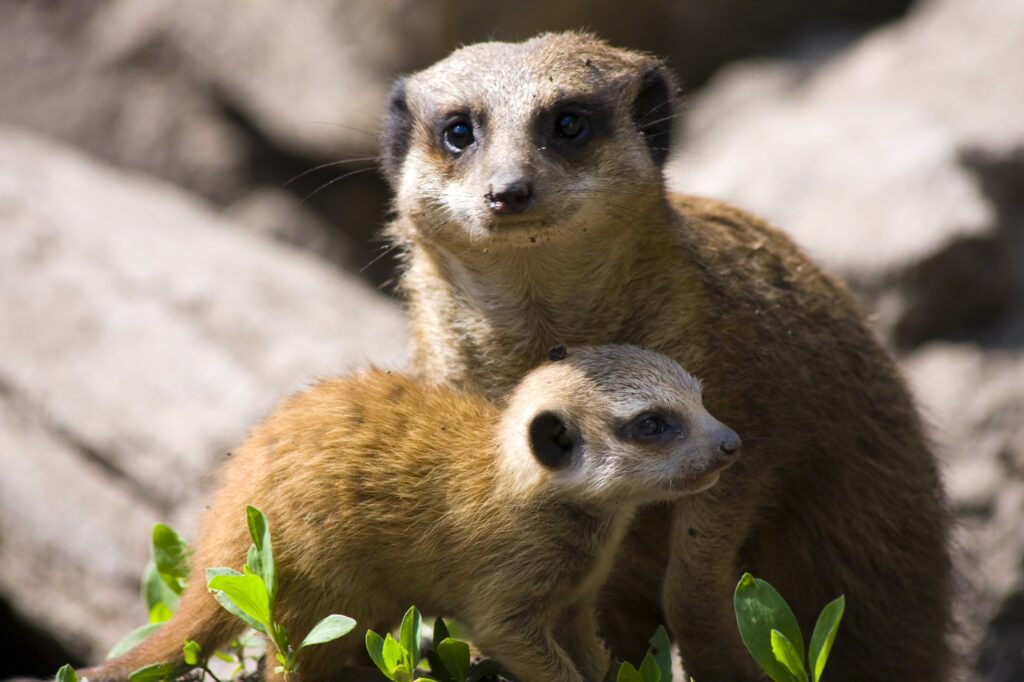
Animal talk&feeding: Meerkat
Meerkats inhabit the open, dry, scrub-covered and rocky regions of Southern Africa. They live in groups of 20–30 individuals, usually made up of two or three families. They build their homes underground, digging extensive networks of tunnels and chambers. They sleep in these burrows, give birth to their young there and retreat into them when threatened.
Some predators can even enter the burrows, so cooperation and well-organised defence can be lifesaving. While the other members of the group maintain the tunnels, search for food, rest or play, one individual acts as a sentry. It stands on an elevated position, watches the surrounding area, scans the sky and alerts its companions if a predator approaches.
When faced with danger, meerkats do not always flee. Sometimes they form a defensive line. If they encounter a rival group or a predator, they may immediately begin digging and create a large cloud of dust. They may also press close together, raise their fur and stretch their bodies to appear as large as possible. At the climax of this intimidating display, the entire group leaps into the air while growling.
The meerkat possesses a characteristic that distinguishes it from other members of the mongoose family: its front feet have only four toes, each ending in a long, powerful claw. This makes the animal exceptionally well adapted to digging.
The fur on its belly is thinner and lighter than on the rest of its body, which plays an important role in regulating body temperature. When a meerkat wants to warm up, it turns its belly towards the sun. When it needs to cool down, it lies flat on its stomach against the cool ground. Its back bears a distinctive striped pattern that differs between individuals, meaning that no two meerkats are exactly alike.
Meerkats are primarily carnivorous and feed mainly on insects, including termites and beetles. They also eat small reptiles and eggs and will even tackle scorpions, which they skilfully disarm before consuming.
Each family within the colony is led by an alpha pair. Only the dominant breeding pair reproduces, but every member of the group helps to raise the pups. While the group searches for food, the pups are gathered together and watched over by a designated adult.
Cooperative care of the young is common among females. Those without pups of their own act as babysitters and help their parents raise their younger siblings.
Meerkats have no fixed breeding season and can mate throughout the year. After a gestation period of approximately 70 days, the female gives birth to 2–5 pups in the family’s underground burrow. A group may raise as many as three litters in a single year.