
Animal talk&feeding: Jaguar
The jaguar is the third-largest cat species in the world. It inhabits tropical and subtropical regions of Central and South America, with a particular preference for rainforests. It is often confused with the leopard, and although the two do look similar at first glance, they differ considerably in both build and geographical distribution.
The jaguar lives in the Americas, while its relative, the leopard – also commonly known as the panther – inhabits Africa and Asia. The jaguar has a more robust build, with a larger, more angular head, a stockier body and shorter limbs. The leopard is more slender and graceful, with a narrower face, longer legs and a longer tail.
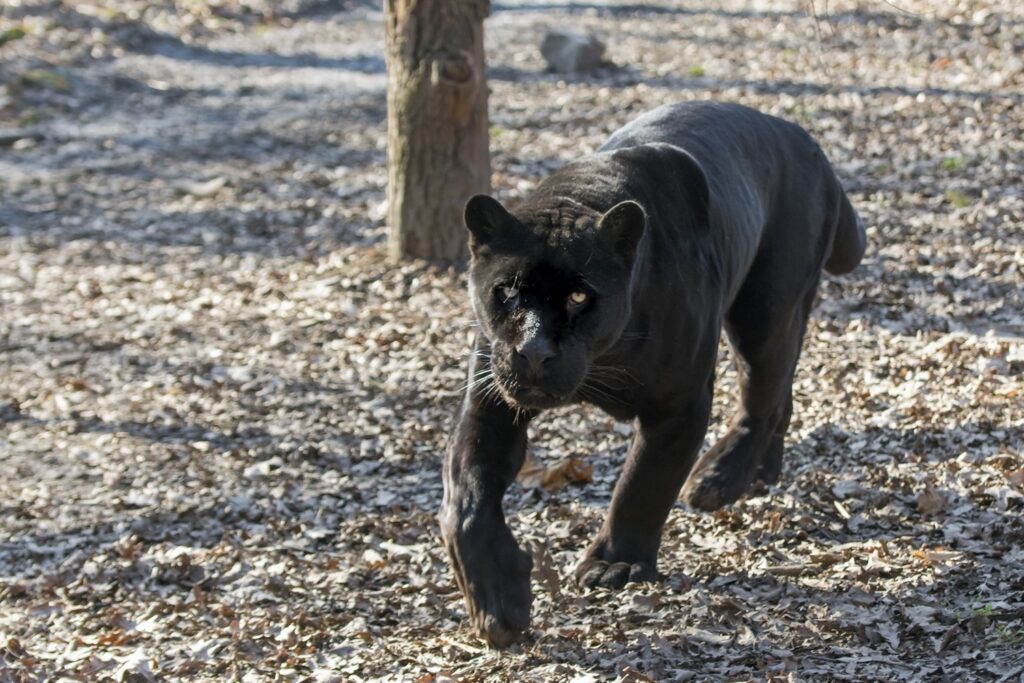
Both species can have a black colour variant, meaning that both black jaguars and black panthers exist. This is known as melanism and is caused by a genetic mutation that results in an excess of dark pigment. The animal’s skin and coat become darker, but its spotted pattern remains. When viewed closely in sunlight, the faint markings can still be seen on the black fur.
The jaguar is an apex predator in its habitat and will readily hunt almost any animal it encounters. It is far from selective: at least 87 species are known to form part of its diet, including deer, caimans, tapirs and capybaras.
Unlike other big cats, the jaguar has a distinctive method of killing its prey: it attacks the head. Approaching from behind and striking from ambush, it typically bites the back of the skull or the base of the neck. Its bite is among the most powerful of all terrestrial mammals and, relative to its body size, is considered second only to that of the hyena. Like hyenas, jaguars can crush bones with their teeth in a matter of seconds and can easily break open a turtle’s shell.
The jaguar moves silently along the ground, cautiously stalking its prey before launching a surprise attack. It does not have great endurance, however, and will not pursue its intended prey over long distances. It is an excellent swimmer and hunts just as skilfully in water as it does on land. It is also a capable climber and, thanks to its immense strength, can drag its prey high into a tree. After a successful hunt, it may consume as much as 25 kilograms of meat, which means it does not need to hunt every day.
Jaguars live alone, with males and females meeting only to mate. They can reproduce throughout the year, although cubs are generally born during periods when food is abundant. After a gestation period of three to three and a half months, the female gives birth to 1–4 cubs. She alone cares for the young. The cubs nurse until approximately three months of age and remain with their mother until they are one or two years old.
The jaguar plays an important role in the beliefs of several peoples of Central and South America, symbolising spiritual power, fertility, water and rain. In Maya tradition, the jaguar was associated with rulership. It was believed to act as an intermediary between the living and the dead and was therefore regarded as a companion in the spirit world. In Aztec civilisation, it also symbolised rulers and warriors. Aztec society even had an elite military order whose members were known as jaguar warriors.
The jaguar is classified as Near Threatened, and its population continues to decline. Its survival is threatened primarily by expanding human activity, the destruction and fragmentation of its natural habitats, conflicts between people and big cats, and hunting for its distinctive spotted coat.