
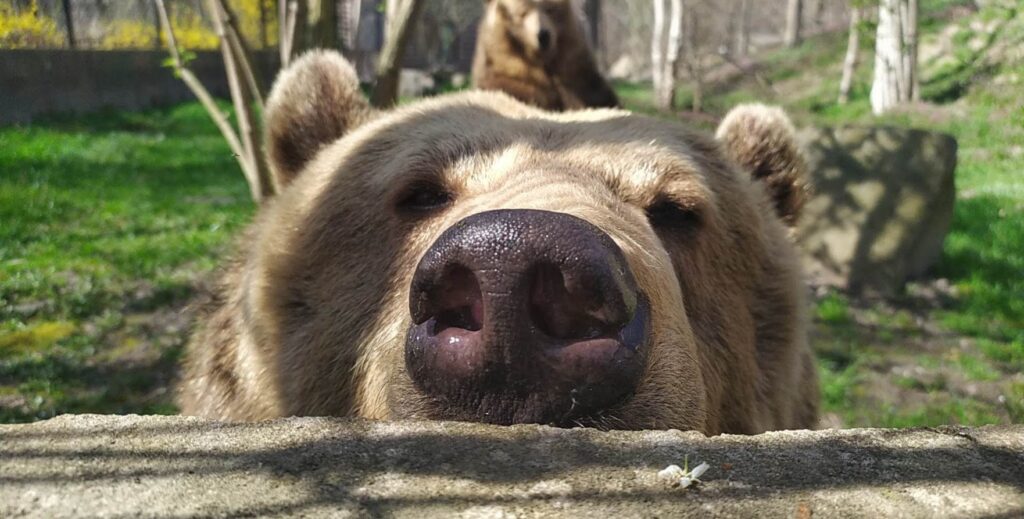
Animal talk&feeding:Brown Bear
Szeged Zoo is home to two elderly female brown bear rescued from a Spanish circus. After their rescue, they were brought to Szeged, where they have now lived for many years. The lighter-coloured bear is Mici, while the darker brown female is Ursula, or Rózi, as her keepers call her. Their exact ages are unknown, but they are estimated to be between 30 and 40 years old.
The brown bear is the most widespread bear species in the world. It has numerous recognised subspecies, the best known of which include the European brown bear, the Kodiak bear of Alaska, the North American grizzly bear, the Tibetan blue bear and the Syrian brown bear.
The subspecies native to Europe has a brownish coat and is medium-sized. It has a distinctive muscular hump over the shoulders, long, curved claws on its front paws and small, rounded ears. As one of the largest terrestrial carnivores, it can measure 1–2.8 metres in length and stand 90–150 centimetres tall at the shoulder.
Brown bears are generally solitary, and males and females usually meet only during the breeding season. Interestingly, they are not strongly territorial, and where food is plentiful, several individuals may temporarily gather in the same place. While foraging, a bear may cover considerable distances, travelling several hundred kilometres over the course of a year. It is most active around dawn and sunset.
Brown bears are omnivorous. Their diet includes leaves, seeds, fruit, fungi, insects, birds and mammals, as well as carrion. Their eyesight is not particularly good, but their sense of smell is exceptional: they can detect a decomposing carcass from several kilometres away.
Contrary to popular belief, brown bears do not enter true hibernation, although their metabolism slows considerably during the winter. Depending on the local climate, their winter dormancy begins between October and December and lasts until March. Subspecies living in southern regions may spend only a short period in winter dormancy or may not enter it at all.
This state is not the same as the deep hibernation characteristic of certain rodents, reptiles and amphibians. Another widespread misconception is that most bears spend the winter in caves. In fact, they often dig dens among large rocks or tree roots and line them with dry vegetation.
The mating season takes place in May and June. After fertilisation, however, the embryo remains dormant for approximately five months. Its active development lasts only 6–8 weeks, and the helpless, hairless and blind cubs are born during the winter. Weighing just 340–680 grams at birth, they can reach 15 kilograms by the age of three months.
There are many misconceptions about how to behave when encountering a bear. Bears generally avoid people, and with appropriate behaviour and preparation, most conflicts can be prevented. It is particularly important never to attempt to lure a bear closer. In areas inhabited by large carnivores, rubbish should be stored securely in closed containers so that it does not become a food source for them. In the wild, bears are just as wary of people as people are of bears. They generally show aggressive behaviour only when cornered or when defending their cubs.
Adult brown bears have few natural enemies, although cubs may be threatened by wolves and other bears. Brown bears occasionally attack sheep and cattle, and for this reason they are still hunted in some regions. Their gallbladders are also used in traditional Asian medicine. Their habitat continues to shrink as a result of deforestation and road construction.
The European brown bear occurred in present-day Hungary until the end of the 19th century. However, due to population growth, habitat loss and hunting, only a few individuals remained in the northern forests by the beginning of the 20th century. The species reappeared in Hungary in 2014, and since then several individuals have been regularly observed in the northern part of the country. In Hungary, the brown bear is a strictly protected species.