
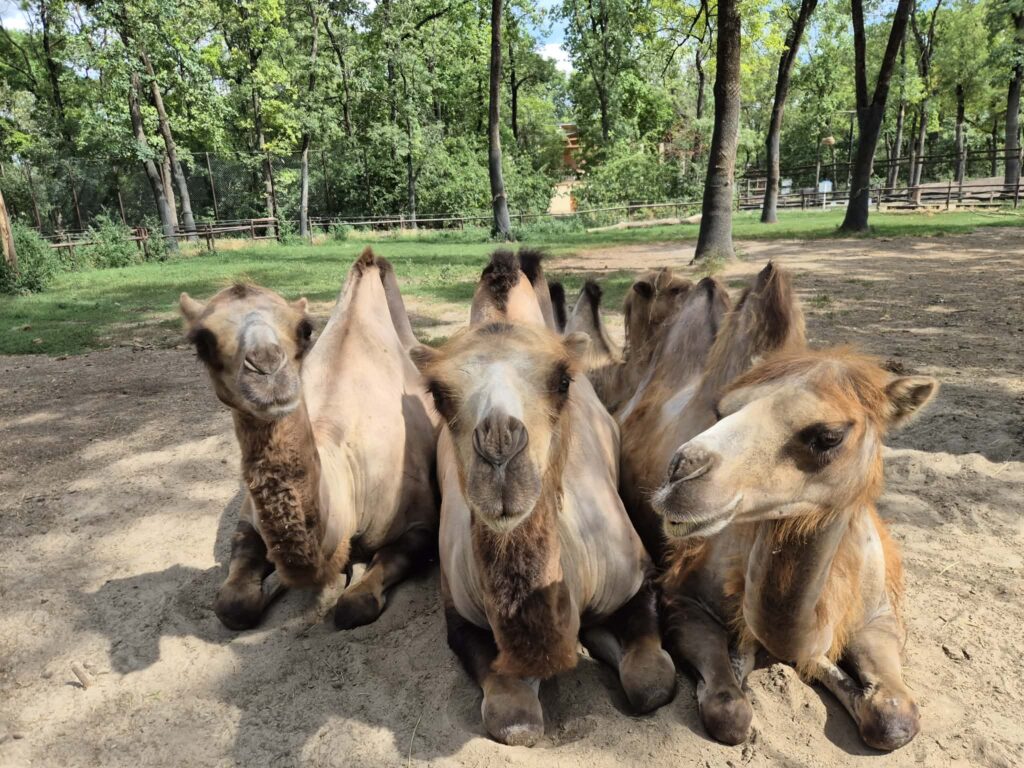
Animal talk&feeding: Bactrian Camel
Wild two-humped camels now survive only in a few parts of the Gobi Desert, where they live in small groups of approximately 30 individuals. They are not known as the “ships of the desert” by chance: for a very long time, crossing the desert was possible only with the help of these animals. Bactrian camels were domesticated approximately 4,000–4,500 years ago.
This remarkably adaptable animal is perfectly suited to the extreme conditions of the desert. In winter, its thick, dense coat enables it to withstand temperatures as low as −30°C, while in summer, when temperatures can reach 35°C, its body is covered with only a thin layer of fur. It sheds its winter coat in large clumps during spring. At this time, its appearance may seem untidy, but this is a completely natural part of its adaptation.
Its broad feet prevent it from sinking into the sand. Unlike other hoofed mammals, its body weight rests not on its hooves but on wide foot pads, with only the front edges of the hooves touching the ground. Its long, thick eyelashes protect its eyes from both intense sunlight and blowing sand. It can also close its nostrils to prevent sand from entering them.
The camel’s humps actually store fat, from which its body can obtain energy and metabolic water when necessary. These reserves are used when food and water are scarce. A camel can survive for as long as two weeks without drinking because the unusual shape of its red blood cells helps prevent its blood from thickening too rapidly. Once it reaches water, it can drink as much as 100 litres at a time.
Bactrian camels are primarily herbivorous and consume almost any available plant or plant-based material. When food is scarce, however, they may resort to eating carrion, bones and even hide. They have also been known to consume human-made objects such as sandals, ropes, blankets and even entire tents.
They live in herds of approximately 30 individuals led by a dominant male. Males engage in fierce battles for access to females. Their breeding season begins in autumn, when the males become aggressive and may even pose a danger to humans.
After a gestation period of approximately 12–13 months, calves are born in March or April. They can stand and walk within just a few hours of birth. Young camels nurse until approximately one and a half years of age and remain with their mothers until they are between three and five years old. They generally live for 20–30 years but may reach the age of 50.
Today, almost all camels are domesticated, and people make use of their great size and strength. They can carry heavy loads over long distances and are also widely used as a means of transport.
The wild two-humped camel is currently threatened with extinction. Only four wild populations are known: three in eastern China and one in the region of Ordos and along the border between China and Mongolia.