
Animal talk&feeding:Don’t Be Afraid of Me – Get to Know Me! Unpopular Animals
Many of the animals you can see here are feared by most people or regarded as disgusting or ugly. Often, however, we simply do not know enough about them, and our fears are unfounded. We would now like to dispel some of the misconceptions surrounding these animals.
Madagascar Hissing Cockroach
The Madagascar hissing cockroach has recently become a widespread and popular pet, as it is docile and relatively easy to care for. It is one of the largest cockroach species and inhabits the forests of Madagascar. As a decomposer, it plays a crucial role in the functioning of its ecosystem. Its diet consists mainly of fallen tropical fruit and leaf litter.
Unlike most cockroach species, it has no wings and therefore escapes danger by running. It also possesses a remarkable defence mechanism: it produces a loud hissing sound. When threatened, it tries to frighten away its attacker with this distinctive noise, which is often compared to the hiss of a snake. The cockroach suddenly contracts its body, forcing air through its respiratory openings and producing the sound through friction.
It has no other means of defence: it neither stings nor bites. Male Madagascar hissing cockroaches engage in spectacular contests. They push one another with the horn-like protrusions on their bodies while hissing continuously. These fights are entirely harmless, although an antenna may occasionally be damaged.
They reach sexual maturity at approximately one year of age and generally live for another year afterwards, with males usually outliving females. The young should not be separated from their parents, as they acquire the gut bacteria essential for digestion by consuming their parents’ droppings.
Central Bearded Dragon
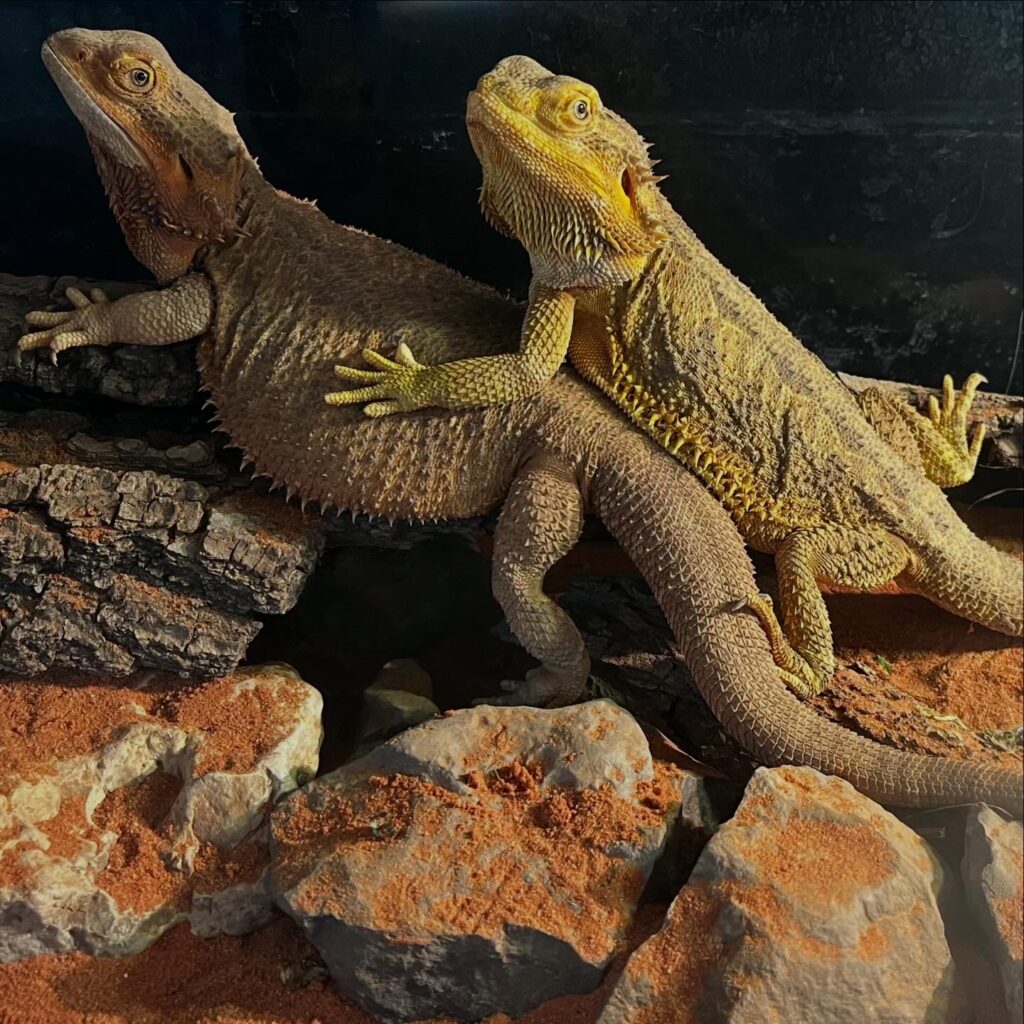
The central bearded dragon is very popular among beginner reptile keepers. It is relatively easy to care for, generally docile and not particularly timid, even when young. The species is widespread across central and eastern Australia, where it inhabits deserts, dry forests and scrublands.
The name “bearded” refers to the spiny scales on its throat pouch. When frightened, it expands its beard, opens its mouth and inflates its body, causing the spines along its sides to stand out as well. In this way, it makes itself appear larger and more intimidating.
Its colour varies throughout its range, from reddish and yellow shades to very dark brown, usually with darker markings. In Australia, the breeding season coincides with spring and summer and lasts from September until March. In captivity, however, this seasonality is not always observed, and the animals may reproduce at any time of the year.
After mating, the female lays her eggs in a burrow that she has dug herself. Young bearded dragons reach sexual maturity at between one and two years of age. They are omnivorous and, because they inhabit environments where food can be scarce, they are not selective feeders. They catch a wide variety of insects and may even prey on rodents and smaller lizards. They also consume large quantities of plant material.
Ball Python
The python family contains more than 20 species of varying sizes, from small to very large. The ball python is one of its shortest members, especially when compared with species such as the Burmese python, which can reach 6–8 metres, or the reticulated python, which may grow to 9–10 metres.
Its scientific name, Python regius, comes from the Latin word regius, meaning “royal”. According to legend, Cleopatra wore snakes of this species around her wrists like bracelets. Its other English name, “ball python”, refers to its defensive behaviour. When threatened, it curls itself into a tight ball, hiding its head and tail.
Ball pythons are mainly active at dusk and dawn. During the day, they generally remain in underground shelters. After laying her eggs, the female coils around them to keep them warm and protected, remaining there until they hatch.
Ball pythons are commonly kept as pets, even in private homes, by snake enthusiasts. When purchasing one, it is essential to request documentation proving that the animal comes from a legal breeding facility and was not illegally captured and smuggled from the wild.
Authorities may also penalise the new owner for possessing an illegally obtained animal. Moreover, purchasing such an individual contributes to the capture of wild snakes, which could eventually lead to the decline or even extinction of their populations.