
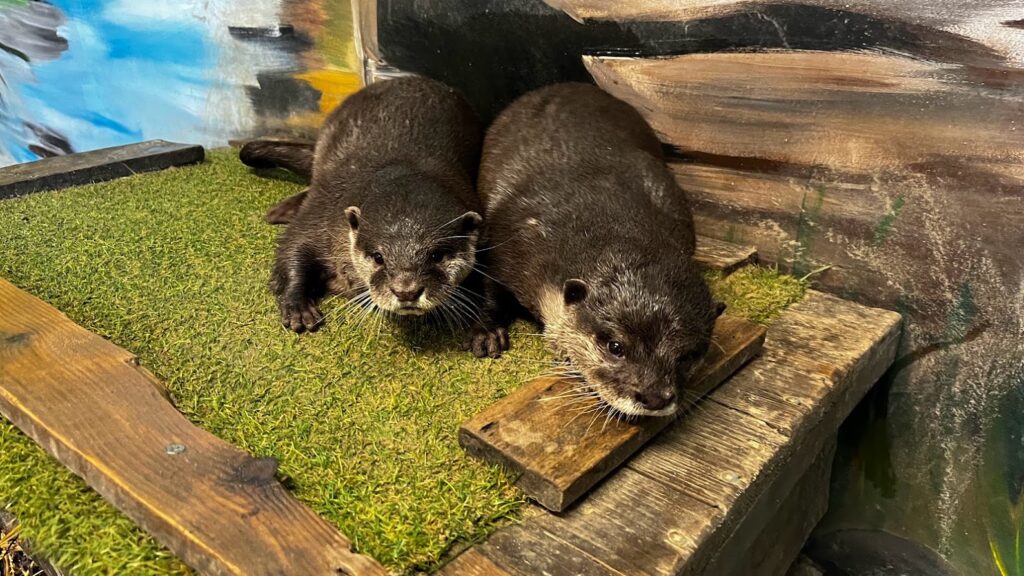
Animal talk&feeding:Asian Small-clawed Otter
The Asian small-clawed otter is the smallest otter species in the world. It inhabits shallow freshwater and coastal habitats across Southeast Asia. Although it belongs to the same family as the Eurasian otter, the two species differ considerably in both appearance and lifestyle. While Eurasian otters are generally solitary, their Asian relatives live in family groups of 6–12 individuals. Eurasian otters are mainly active from dusk until dawn, whereas Asian small-clawed otters are active during the day. They are also much smaller, weighing only 3–5 kilograms, compared with Eurasian otters, which can weigh as much as 14 kilograms.
The species takes its name from its exceptionally short claws, which leave its highly mobile fingers almost entirely unobstructed. This makes its front paws remarkably dexterous: it can use them to grasp, crush and open shellfish, crabs and snails. It also likes to “wash” its prey in the water before eating it.
Otter families are very close-knit. Each group has a monogamous breeding pair, and the female may give birth to as many as two litters a year. After a gestation period of 60–64 days, she gives birth to 2–6 pups. The young open their eyes at around 40 days old and take their first swim at 7–9 weeks of age. The male and older siblings also help to care for the pups.
The Asian small-clawed otter feeds mainly on crustaceans, molluscs and fish, but it may also catch frogs, small mammals, snakes and insects. Their diet here at the zoo is similar, with crucian carp, eggs and mealworms among their favourites. They use their front paws with great skill to find prey beneath stones and in the mud.
These otters are highly playful and love playing with small pebbles. They can often be seen lying on their backs and juggling stones, or hiding their favourites – sometimes even slipping them into their keeper’s boots. They also enjoy “gardening”: they collect various weeds from their outdoor enclosure and carry them into their shelter to use as bedding. They are extremely curious and have excellent problem-solving skills. Their chirping calls can be heard from a considerable distance, and their communication is highly sophisticated: researchers have identified 12 distinct vocalisations.
Their numbers have been declining for decades due to overfishing, habitat destruction, water pollution and hunting. Sadly, many are also captured and kept illegally as pets. Asian small-clawed otters disappeared from records in Nepal for almost two centuries, but scientists have recently confirmed the species’ presence in the country once again. Conservation organisations also place great emphasis on educating local communities and promoting fishing methods that are less harmful to the environment and to otters.