Animal talk&feeding:African Penguin
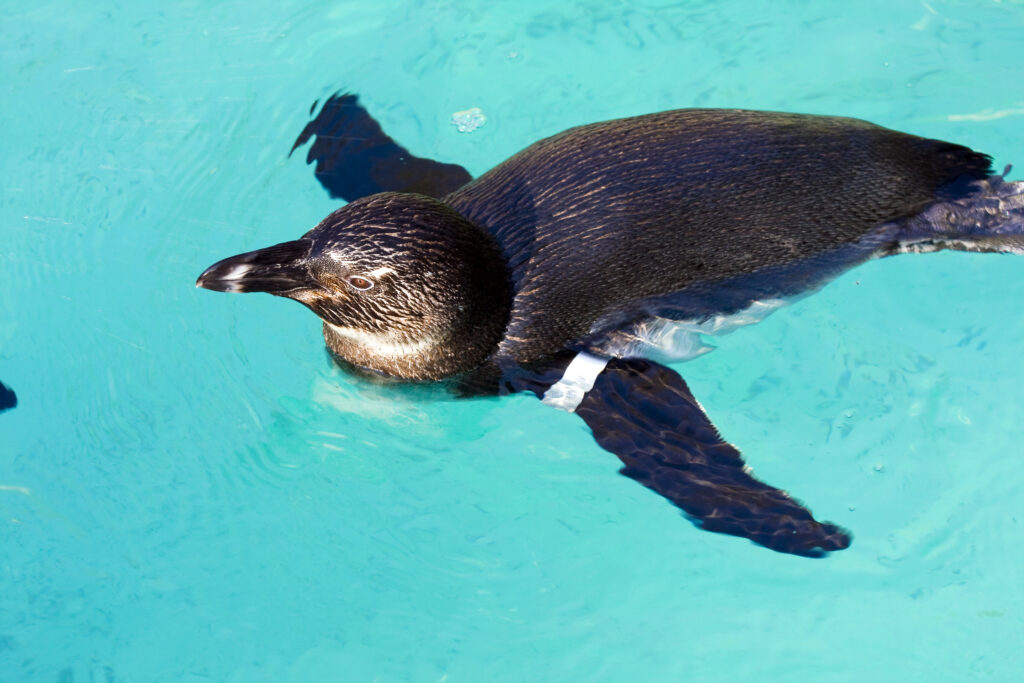
The African penguin is the only penguin species native to Africa. It lives and breeds in colonies along the rocky coastlines and on the islands of Southern Africa. The Hungarian name of the species, meaning “spectacled penguin”, refers to the pink patches of bare skin above its eyes. These play a role in regulating the bird’s body temperature.
Like its relatives from the polar regions, the African penguin has black-and-white plumage, although it is considerably smaller. Its tuxedo-like appearance provides effective camouflage. When seen from below, its white belly blends in with the bright surface of the water, helping to conceal it from aquatic predators. From above, its black back merges with the darker depths, making it less visible to predatory birds.
Although there is a slight difference in size between males and females, individual penguins can be identified most easily by the arrangement of the black spots on their bellies. This pattern is unique to every penguin, much like a human fingerprint.
Although penguins are birds, they cannot fly because they have adapted to an aquatic way of life. Instead of using their wings to fly through the air, they use them to propel themselves through the water. Like flying birds, they have a large keel on their breastbone, to which the powerful muscles required for swimming are attached. Their short, webbed feet act as rudders and are positioned towards the rear of their streamlined bodies.
Unlike the hollow bones of flying birds, penguins have dense and heavy bones, which make diving easier. The fastest penguins can swim at speeds of up to 36 kilometres per hour. Some species can dive to depths of 30 metres and remain underwater without breathing for 15–20 minutes.
African penguins hunt primarily for marine fish, particularly sardines and mackerel, although they also consume marine invertebrates such as squid and small crustaceans.
The African penguin is monogamous and forms a lifelong pair bond. It can reproduce throughout the year, although mating occurs mainly between November and May. The female lays her eggs in nesting burrows among rocks, and the chicks hatch after 38–42 days.
At first, the chicks do not resemble their black-and-white parents. Their plumage is dull, with a greyish-brown back and a cream-coloured breast. They moult into their adult plumage at approximately three years of age.
As with other birds, preening is essential for penguins. Without regular preening, the feathers become dirty and disordered and can no longer provide adequate protection against either cold or heat. In flying birds, poorly maintained feathers are also unable to perform their role properly, which may prevent the bird from finding food or escaping from danger.
Most birds preen entirely on their own. African penguins, however, have been observed helping one another arrange and clean the feathers on their heads and necks.
In 2008, the African penguin was still classified as Vulnerable on the IUCN Red List. Its population has since declined considerably, primarily because of intensive fishing and the resulting reduction in the number of available prey animals. Oil spills caused by tanker accidents along Southern Africa’s busy shipping routes also pose a serious threat and may kill thousands of penguins.
To prevent further drastic population decline and the species’ eventual extinction, conservation measures have been strengthened, and the African penguin was reclassified as Endangered. A European conservation breeding programme has also been established to help maintain the species, and Szeged Zoo participates in this programme.