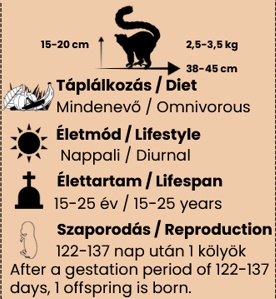

Ring-tailed lemur (Lemur catta)
Habitat: Ring-tailed lemurs are found only in southern and southwestern Madagascar. They prefer gallery forests, forests near and following the riverbanks, but can be found in dry scrub, montane humid forests, and deciduous forests.
Food habits: They can and will eat whatever is easily available to them including fruits, leaves, stems, flowers, exudates (resin, latex, sap), spiders, spider webs, chameleons, caterpillars insects, small birds, and termite mounds.

Native to Madagascar and the Comoro Islands, lemurs are classified as strepsirrhines (often referred to as prosimians). They earned this classification by possessing certain primate characteristics—such as flat nails and opposable thumbs—while retaining more primitive traits, such as their specific dental structure, which distinguish them from “true” monkeys.
The most iconic member of this group is the ring-tailed lemur. It is easily identified by its long, black-and-white banded tail, which it carries in a high, characteristic arch while moving. Unlike many other lemur species, ring-tailed lemurs are highly terrestrial and spend a significant amount of time on the ground. They are also diurnal, being active during daylight hours.
They live in complex social groups that can number up to 30 individuals. These troops are female-dominant, with males adhering to a strict social hierarchy. One of their most distinctive social displays is communal sunbathing in the early morning, where they sit in an upright “yoga-like” posture to absorb warmth.
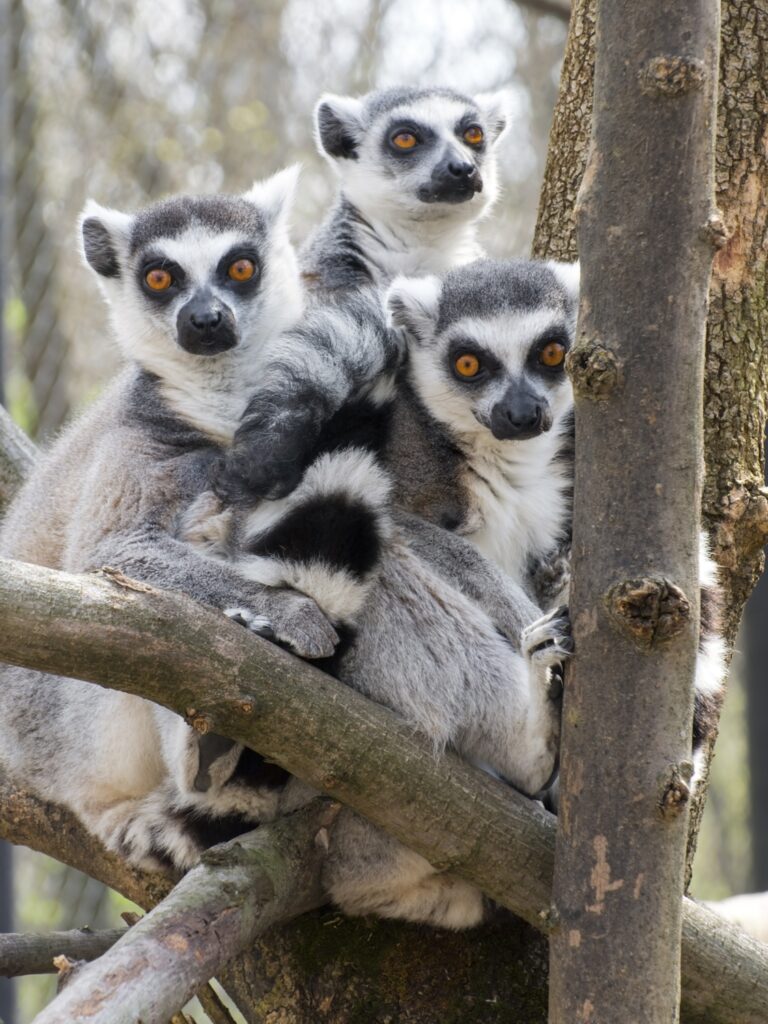
Communication within the troop is highly sophisticated, involving visual, vocal, and olfactory signals. They are capable of producing 28 distinct vocalizations. Their long tails, which consist of 30–32 black-and-white rings, serve not only for balance but also as visual “flags” to maintain group cohesion during travel.
Scent marking is perhaps their most vital communication tool. They possess specialized scent glands located on their wrists, in their armpits (axillary glands), and in the anogenital region. These chemical signals, combined with their striking visual displays, allow for a complex exchange of information within the troop.
Főemlősök rendje (Primates)
Makifélék családja (Lemuridae)
IUCN Redlist: EN (Endangered)



I.